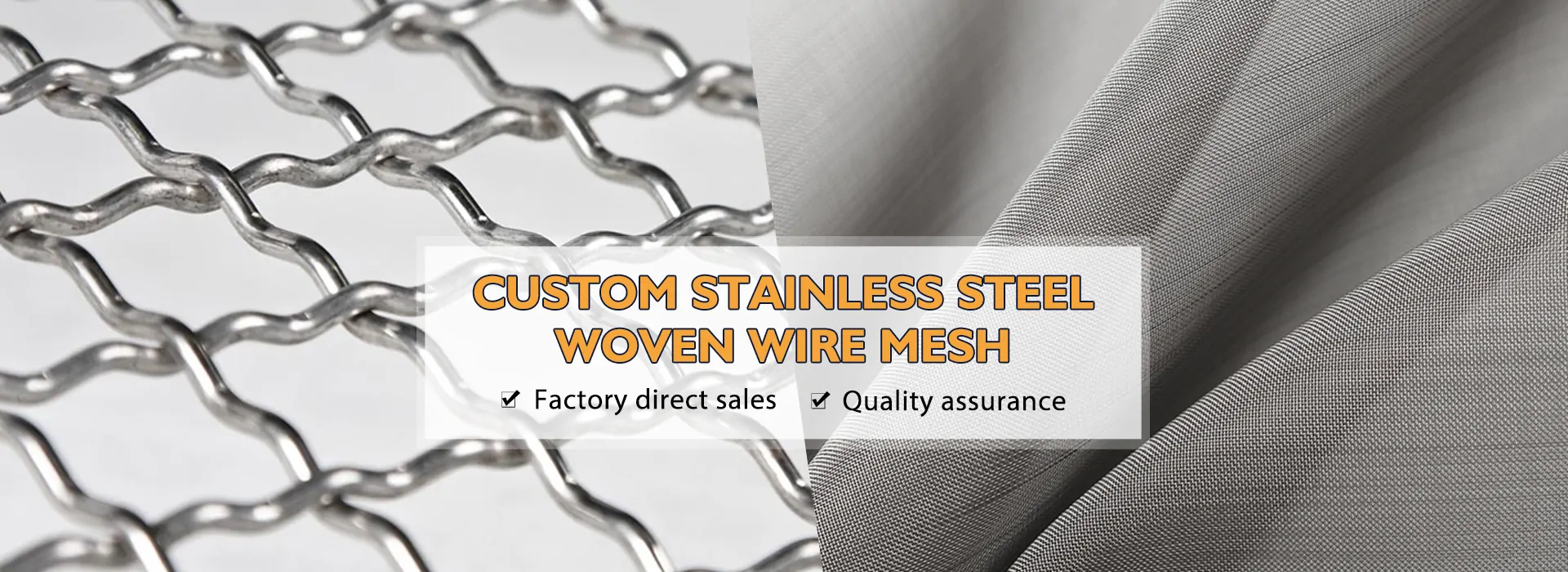
Woven wire mesh professional manufacturer look forward to working with you!                      Call Us: +86-13932878588(Tel/Whatsapp)
banner
banner2
banner3
HOT  Products
Looking for the adequate product solution for your company?Take a look at these
Stainless Steel Twill Woven Mesh
Type:Weave Wire Mesh
Material:Stainless Steel Wire
Filter Rating:5-300um
Size:Cutomized,2 to 400
Tensile Strength:900-1300 MPa Shipment after professional inspection
 
View More
Stainless Steel Crimped Wire Mesh
crimped wire mesh possesses excellent structural stability, enabling it to withstand certain mechanical pressure and external impacts without easily deforming. The embossing on the wires ensures that each intersection is firmly locked, preventing the wires from shifting during use.
View More
Galvanized Fence Wire Roll
Commercial grounds (Corporation, hotel, supermarket)
Private grounds (Courtyard, Villadom)
Public grounds (Park, zoo, train or bus station, lawn);
Road and transit (Highway, railway or road city transit);
Cyclone Wire is used as fencing, decoration or protection for various facilities in industry , 
agriculture, infrastructure,transport, etc.
View More
Wedge Wire Screen
Wedge wire is known as profile wire screen, V- wire screen, and wedge wire screen.It is a filtering device woven from stainless steel wedge-shaped wire, mainly used for solid-liquid separation, material screening, and impurity removal in the industrial field.
View More
About Tuojiang Wire Mesh
       We are a wire mesh manufacturer. Our advantage lies in visualizing the entire process from raw material entry into the factory, mold sample production, customer confirmation, mass production, logistics tracking, to customer acceptance. 
       We provide customized solutions for pipeline filtration, mining screening, construction machinery mesh belts, road safety protection facilities, river reinforcement and protection, agricultural fences, green belt protection, fluid screening and filtration, indoor decoration, storage protection facilities, sports stadium fences and other application scenarios in the petrochemical industry. 
    Our ideal is to create a better world with our products. 
 

Qualification Certificate

Knowledge Blog

  • What are some common problems with stainless steel wire mesh?

    During use, stainless steel wire mesh may encounter some common problems, which are usually related to materials, environmental conditions, usage methods, and maintenance.

    1. Corrosion
    2. Deformation or Elongation
    3. Mesh Opening Deformation
    4. Clogging
    5. Uneven Mesh Size
    6. Wear and Tear
    7. Welding or Joint Issues

    To address these common issues, it's essential to consider the environment, usage methods and regular maintenance when using stainless steel wire mesh. By selecting the appropriate wire diameter, alloy material and mesh size for the specific application, you can significantly extend the lifespan and improve the performance of the mesh.
  • What are the global industry standards for stainless steel woven wire mesh?

    Global Stainless Steel Woven Wire Mesh Standards Comparison

    Region / Organization Standard No. Applicable Material Application Features / Notes
    China (GB/T) GB/T 4237-2015 304/316/201stainless steel wire Industrial,construction,chemical Chemical composition、mechanical properties、wire dimensions

    GB/T 10006-1988 Metal wire Woven wire mesh Mesh size、wire diameter、weaving method

    GB/T 3280-2015 Stainless steel bars, wires, profiles Industrial Mechanical properties,tensile strength

    GB/T 10125-2012 Stainless steel wire mesh Corrosion resistance testing Salt spray test,corrosion performance
    United States (ASTM) ASTM A313 304/316 Chemical,petroleum,filtration Stainless steel wire technical requirements

    ASTM A580/A580M Stainless steel wire Industrial,construction Wire diameter, tensile strength

    ASTM E2016 Metal wire mesh Filtration Mesh size,pressure resistance,precision
    Europe (EN) EN 10218 Steel wire and ropes Industrial Material,mechanical properties

    EN 10223-3 Woven metal wire mesh Chemical,construction Mesh size,weaving method

    EN 10271 Welded wire mesh Filtration,sieving Strength,corrosion resistance
    International (ISO) ISO 9044:2017 Metal wire Aperture measurement Optical method for aperture determination

    ISO 4783 Industrial wire mesh Sieving,filtration Globally recognized standard

    ISO 3310 Test sieves Powder sieving Mesh size and test method
    Industry / Special API 6A/6D 316/316L Oil & gas pipeline filtration High-pressure wire mesh

    FDA/EU 1935/2004 Food-grade stainless steel Food,pharmaceutical Food contact safety,corrosion resistance

  • Key factors to consider when purchasing stainless steel woven wire mesh(2)

    4. Working Pressure and Flow Rate Requirements
    The working pressure and flow rate requirements of stainless steel mesh directly determine the load it must bear. When selecting mesh, confirm the maximum working pressure it can withstand to avoid rupture or clogging during use.

    5. Temperature Resistance Requirements
    Temperature resistance is another key factor to consider when purchasing stainless steel mesh, especially in high-temperature applications. For example, in hot water treatment, food processing, or chemical processing, the mesh may be exposed to high-temperature working conditions.

    6. Supplier Quality Assurance and After-Sales Service
    When selecting a supplier for stainless steel mesh, quality control and after-sales service are critical. A reliable supplier ensures product quality and provides timely after-sales support in case of issues. Supplier reputation, quality certifications, and customer reviews are important evaluation criteria.

    7. Cost and Budget
    Finally, cost is an essential factor in purchasing decisions. While high-quality mesh may require a higher initial investment, its durability and low maintenance costs can save the company long-term operational expenses.


    When purchasing stainless steel woven wire mesh, several key factors need to be considered, including material selection, weaving method, aperture size, working pressure, and temperature resistance. Purchasing managers and project leaders need to consider these factors based on the specific project requirements to select the most suitable product. At the same time, choosing a supplier with reliable quality control and after-sales service ensures the long-term stability and reliability of the product, avoiding unnecessary maintenance and replacement costs.
  • Key factors to consider when purchasing stainless steel woven wire mesh (1)

    So, what key factors should purchasing managers and project leaders consider when buying stainless steel woven wire mesh?

    1.Material Selection
    The material of stainless steel mesh directly affects its corrosion resistance, strength, and service life. Common stainless steel materials include 304 and 316 stainless steel. Different materials are suitable for different working environments, so choosing the right material is very important.

    2.Weaving Method
    There are several types of weaves for stainless steel woven wire mesh, such as plain weave, twill weave, and dutch weave. Different weaves affect filtration efficiency, pressure resistance, and durability. When purchasing, choose the right weave based on the project's requirements.

    3.Mesh Aperture Size and Flow Requirements
    The aperture size of stainless steel mesh directly affects its filtration precision. Smaller apertures filter finer particles, but at the cost of increased flow resistance. Therefore, the aperture size should be chosen based on the actual flow requirements.


    The above are the prerequisites for the first stage.
  • 7 Key Factors for Choosing Stainless Steel Wire Mesh in the Chemical Industry

    In chemical production, filtration is a critical process. Stainless steel wire mesh is the preferred choice for chemical filtration due to its corrosion resistance, high-temperature tolerance, high strength, and precise mesh structure. However, the performance of products varies significantly among different suppliers, so chemical companies need to focus on the following seven key areas when procuring wire mesh to ensure safe, stable, and efficient production.
    1.  Material and Corrosion Resistance
    2. Mesh Precision and Uniformity
    3. Mechanical Strength and Pressure Resistance
    4. High-Temperature Resistance
    5. Cleanability and Reusability
    6. Supplier Qualifications and Service
    7. Cost and Value for Money

    Conclusion:
    When procuring stainless steel wire mesh for the chemical industry, focusing on corrosion resistance, mesh precision, mechanical strength, high-temperature resistance, cleanability, supplier qualifications, and cost helps companies select the most suitable supplier, ensuring safe, stable, and efficient production.
  • Stainless Steel Types, Nickel Content & Applications

    Stainless Steel Type Nickel Content (%) Crystal Structure Key Performance Features Typical Applications
    304 Austenitic Stainless Steel 8–12 Austenite Good corrosion resistance and toughness, easy to fabricate and weld Kitchenware, chemical equipment, pipelines
    316 Austenitic Stainless Steel 10–14 Austenite Excellent resistance to seawater and chemical corrosion Chemical, pharmaceutical, marine equipment
    430 Ferritic Stainless Steel 0–0.5 Ferrite Resistant to general oxidation, lower toughness Appliance casings, decorative panels
    Martensitic Stainless Steel 0–1 Martensite High strength, good wear resistance, moderate corrosion resistance Knives, bearings, mechanical parts
    2205 Duplex Stainless Steel ≈5 Ferrite + Austenite Combines high strength and toughness, excellent corrosion resistance Petrochemical equipment, pressure vessels

  • Choosing the Right Stainless Steel Wire Mesh: 304, 316, or 316L?

    In this article, we will analyze the common materials used in stainless steel wire mesh—304, 316, and 316L—and discuss their advantages and disadvantages to help you choose the right material based on your specific needs.

    1. 304 Stainless Steel Wire Mesh
    304 Stainless Steel, also known as 18/8 stainless steel, is one of the most commonly used stainless steel materials. It mainly consists of 18% chromium and 8% nickel, offering excellent oxidation and corrosion resistance.
    •Pros:
    Good Corrosion Resistance: 304 stainless steel wire mesh performs excellently in most industrial environments, effectively resisting oxidation and corrosion.
    High Strength: 304 stainless steel offers good mechanical properties, capable of withstanding high pressure and tension, making it suitable for high-strength screening and filtration tasks.
    Cost-Effective: Compared to 316 and 316L, 304 stainless steel is more affordable, making it a good choice for applications that don't require high corrosion resistance.
    •Cons:
    Less Corrosion Resistance in Harsh Environments: In certain extreme environments (e.g., chloride-containing environments), 304 stainless steel may experience localized corrosion.
    Lower High-Temperature Resistance: Although 304 stainless steel has a certain degree of heat resistance, it may deform or oxidize at very high temperatures.
    •Suitable Applications: 304 stainless steel wire mesh is widely used in everyday filtering, screening, and decorative applications, especially in industries such as food processing and petroleum.

    2. 316 Stainless Steel Wire Mesh
    316 Stainless Steel, often referred to as "marine-grade stainless steel," contains 16% chromium, 10% nickel, and 2% molybdenum. The addition of molybdenum significantly enhances its corrosion resistance, especially in chloride-rich environments.
    •Pros:
    Superior Corrosion Resistance: 316 stainless steel offers excellent resistance to chlorides and other chemicals, making it ideal for marine and chemical environments.
    Better High-Temperature Resistance: 316 stainless steel performs better under high-temperature conditions, making it suitable for high-temperature filtration and screening tasks.
    Wear Resistance: 316 stainless steel is also highly wear-resistant, making it suitable for industrial applications with high abrasion.
    •Cons:
    Higher Cost: Due to the addition of molybdenum, 316 stainless steel is more expensive than 304, which may not be suitable for applications with tight budgets.
    Not Ideal for Extreme Temperature Conditions: While 316 stainless steel has better high-temperature resistance than 304, it may still lose some of its performance in extremely high temperatures.
    •Suitable Applications: 316 stainless steel wire mesh is commonly used in marine, chemical, and pharmaceutical industries, where high corrosion and temperature resistance is essential, such as in chemical filtration and seawater filtration.

    3. 316L Stainless Steel Wire Mesh
    316L Stainless Steel is a low-carbon version of 316 stainless steel. Its lower carbon content reduces the formation of carbide precipitates, thus improving its corrosion resistance.
    •Pros:
    Enhanced Corrosion Resistance: The low carbon content of 316L stainless steel provides better corrosion resistance, especially in high-temperature environments or in welded areas.
    Superior High-Temperature Performance: Compared to 316 stainless steel, 316L performs better in high-temperature filtration applications.
    Ideal for High-Precision Applications: It is particularly suitable for industries requiring high cleanliness and sanitary conditions, such as the pharmaceutical and food industries.
    •Cons:
    Highest Cost: Due to its superior properties, 316L stainless steel is the most expensive option, making it suitable for high-end applications with more significant budgets.
    •Suitable Applications: 316L stainless steel wire mesh is often used in high-end filtration equipment, pharmaceutical industries, and food industries, where high sanitation and corrosion resistance are required.

    How to Choose the Right Material?
    When selecting stainless steel wire mesh materials, the specific conditions of the working environment must be considered. Each type of stainless steel has its own advantages. 304 stainless steel is suitable for general environments, while 316 stainless steel is more suitable for demanding environments. For industries requiring the highest corrosion resistance and high-temperature resistance, 316L stainless steel is the preferred choice. Understanding the advantages and disadvantages of these materials will help you make the right choice, thereby improving efficiency and reducing maintenance costs.

    If you have further questions or need assistance in selecting the right stainless steel wire mesh, feel free to contact us. We are happy to provide technical support and recommendations.

  • Guide to Stainless Steel Woven Wire Mesh: Materials& Weaving Methods

    Introduction:
    Stainless steel woven wire mesh is widely used in various fields such as industry,filtration, and agriculture. Due to its excellent corrosion resistance, strength, and high-temperature resistance, this material has become the standard choice for many industries. In this article, we will discuss in detail the various types of stainless steel woven wire mesh, their technical characteristics, and how to select the appropriate product for different needs.

    1. Basic Structure of Stainless Steel Woven Wire Mesh
    Stainless steel woven wire mesh is made by interlacing stainless steel wires (such as 304, 316, 316L, etc.) using plain weave, twill weave, or patterned weave methods. It has good corrosion resistance and mechanical properties. The main materials used include 304 stainless steel, 316 stainless steel, and 316L stainless steel.
    304 Stainless Steel Wire Mesh: Widely used in general environments, it has strong corrosion resistance and is suitable for low-temperature, low-corrosion applications.
    316 Stainless Steel Wire Mesh: Suitable for chemical or marine environments, it has stronger corrosion resistance and oxidation resistance.
    316L Stainless Steel Wire Mesh: Has a lower carbon content than 316, making it suitable for environments with higher corrosion resistance requirements.

    2. Weaving Methods of Stainless Steel Woven Wire Mesh
    Stainless steel woven wire mesh is mainly classified into the following types according to its weaving method:
    Plain Weave: This is the most common weaving method, suitable for low to medium strength requirements. Plain weave has good air permeability and filtration performance, and is widely used in filtration, separation, and other fields.
    Twill Weave: Twill weave has a more uniform mesh shape and is suitable for high-strength, high-precision applications. It is commonly used in high-requirement industries such as petrochemicals and oil filtration.
    Dutch Weave: This weaving method is formed by interlacing wires of different coarse and fine ratios, resulting in higher precision and pressure resistance. It is often used in precision filters, liquid filtration, and other fields.

    3. Main Applications of Stainless Steel Woven Wire Mesh
    Stainless steel woven wire mesh has wide applications across various industries due to its high strength, corrosion resistance, and customizability:
    Construction Industry: In the construction industry, stainless steel wire mesh is used for protection, decoration, and reinforcement of doors and windows, providing strong structural support.
    Filtration Industry: Stainless steel woven wire mesh is widely used for the filtration of liquids and gases, especially in high-temperature and high-pressure environments, where its filtration effect is excellent. It is widely used in the chemical, petroleum, and food industries.
    Agriculture: Stainless steel wire mesh is widely used as animal cages and bird nets, possessing corrosion resistance and rust resistance, effectively resisting harsh weather and external environments.
    Industrial Manufacturing: In industrial manufacturing, wire mesh is often used in screening, separation, and dewatering processes, ensuring product quality and production efficiency.
     
    If you are looking for stainless steel woven wire mesh, please contact us for professional advice and customized solutions to meet your specific application needs.

  • What is woven wire mesh used for?

    Wire mesh is used in construction, agriculture, food processing, pharmaceuticals, mining, and petrochemicals for applications like filtration, fencing, safety screens, reinforcement, and equipment protection.

Discover Our Premium Stainless Steel Wire Mesh Solutions!

Enhance your projects with our high-performance stainless steel wire mesh—engineered for durability, precision, and versatility. Whether you need reliable filtration, secure screening, or decorative applications, our products deliver exceptional quality tailored to your requirements.
Contact Us

Premium Materials

Selected 304/316 stainless steel, corrosion & oxidation resistant, withstands harsh environments (acid/alkali/high temp)

Precision Craftsmanship

0.02-3mm wire diameter range, plain/twill/dutch weave options, ±0.01mm accuracy

Custom Solutions

Custom patterns & samples accepted, rapid prototyping for filtration / screening / protection needs

Efficient Service

24-hour response, same-day shipping for stock items, professional technical support & after-sales
KNOWLEDGE
Application Cases
Stop Losing Time & Money on Wastewater Filters | Stainless Steel Mesh Solutions

Are Your Filters Costing You Thousands? Frequent filter clogging? High replacement costs? Regulatory risk?

Anti-Climb Fence

In addition to 358 Mesh Fencing、Ornamental Fence, we also offer another type of high-security Intrusion-resistant fencing—a combination of razor wire and welded wire, or chain link fencing. High-security Intrusion-resistant fencing is an ideal anti-climb option for protecting racetracks, racetr

Hexagonal Gabion Mesh

Hexagonal Wire Mesh Hexagonal wire mesh is a twisted steel wire mesh with hexagonal openings. Our hexagonal wire mesh is available in a variety of mesh sizes, in a variety of widths and lengths.It has a wide range of applications, including gabion mesh, insulation layers, and animal enclosures.

Partner Country

Anping County Tuojiang Woven Wire Mesh Products Co., Ltd.
We are a manufacturer of stainless steel woven wire mesh with 20 years of experience. We have independently developed hundreds of products, have dozens of production lines, and have established long-term cooperation with 30 countries around the world.
Follow Us On Social Media

Quick Links

Products Categories

Contact Us
  +86-13932878588
  +86-13932878588
  Beihoutuan Village, Anping County, Hengshui City, Hebei Province, China
Copyright © 2025 Anping County Tuojiang Metal Wire Mesh Products Co., Ltd. All Rights Reserved. Sitemap